An Ode to Oatmeal

Breakfast is my favorite meal of the day. I wake up hungry every day and there’s nothing I look forward to more than a big ol’ brekky: warm croissants, buttered toast, bacon. Mmmm! My absolute favorite breakfast though (and I’m not including brunch here) is oatmeal.
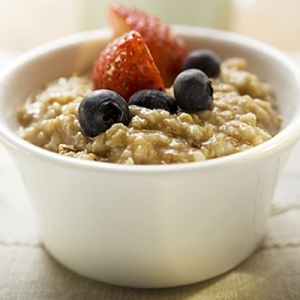
I didn’t buy into oatmeal until pretty late in life. It wasn’t all that popular when I was growing up in England and, even if people ate it, they called it porridge and it was a nasty looking thing that reminded me of gruel a la Charles Dickens. When I first started working, I spent a few months in New York and was surprised to discover that a large chunk of my “Analyst class” bought fresh oatmeal at the company cafeteria every single morning. I finally tried it. Bland, watery and cardboard-like in texture, it wasn’t something I felt like pursuing.

After a year working in London, oatmeal grew on me. As it turned out, its popularity stretched beyond the New York office and, with some nicer-tasting British oatmeal and the right combination of toppings, it was actually kind of good. Besides, I discovered there were other advantages to this quaint old breakfast (note that I’m not talking about any of that instant stuff, I’m talking real steel cut and traditional rolled oats).
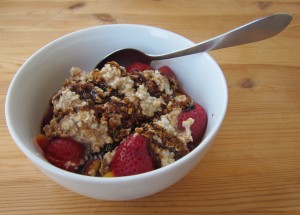
Here are Five Reasons You Should Eat Oatmeal:

1. For starters, it is FILLING. Oatmeal has a very low glycemic index, which means that it breaks down and releases glucose slowly and steadily. That feeling of elation (sugar high) that comes after ingesting large quantities of sugar and starch is a result of elevated glucose levels in the blood stream. High levels of glucose trigger the release of insulin, a hormone produced by the pancreas. Insulin directs the body to take the glucose in the blood stream and store it as glycogen. The sugar “crash” that follows a “high” is a sign that your body’s insulin has reigned in the glucose. This sudden depletion often results in a wave of fatigue and hunger!  Frequent and sudden rises in glucose can have terrible effects, including straining the pancreas, insulin resistance (leading to hyperglycemia and type II diabetes) and oxidative damage to the heart (encouraging heart disease).

Consuming low GI foods like oatmeal have two blood sugar benefits: first it keeps you feeling full for longer periods of time, curbing the urge to snack on sugary treats and, second, because a moderate and sustained rise in blood glucose is easier on your pancreas, it reduces the risk of type II diabetes. Starting your day with a blood sugar stabilizing food like oatmeal may make it easier to keep blood sugar levels under control the rest of the day.

2. It lowers CHOLESTEROL and the risk of heart disease.  Oatmeal contains high levels of (water) soluble fiber, known as beta-glucan.  Soluble fiber becomes gooey when dissolved in water, allowing it to travel slowly through the digestive tract and to attach to bile acids in the intestine and escort them out of the body as waste.  Since bile acids are made from cholesterol, the liver then has to pull more cholesterol from the blood in order to continue producing these acids.  Foods like oatmeal, which are rich in soluble fiber have been proven to reduce total and LDL (bad) cholesterol without affecting the levels of HDL (good) cholesterol, thus lowering the risk of heart disease.

Studies show that in people with high cholesterol (above 220 mg/dl), just 3 grams of soluble oat fiber per day (an amount found in one bowl of oatmeal) will lower total cholesterol by 8-23%. This is highly significant since each 1% drop in cholesterol translates to a 2% decrease in the risk of developing heart disease.
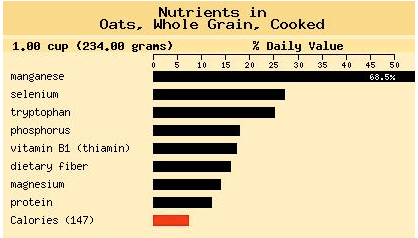
3. It helps prevent CANCER.  Oatmeal is rich in a variety of antioxidants including vitamin E, tocotrieonols, selenium, phenolic acids, and phytic acid. It is also rich in protein, calcium, manganese, magnesium, phosphorus and B vitamins such as niacin, thiamin, riboflavin and vitamin B6.  These vitamins and minerals, together with the fiber present in oatmeal have been shown to result in reduced risk of cancer, particularly colon and breast cancer.
4. It boosts IMMUNITY.  Studies have shown that beta-glucan helps immune cells to speedily reach the site of infection and locate the germs present there, rapidly healing infections. Moreover, oat also contains zinc, a prominent trace mineral needed to boost immunity. For more on this, click here.

5. It is HOT and delicious!  Now, you might underestimate the value of a hot breakfast, but if you’ve ever lived in a climate as dreary as London’s you will know that it is indispensable. Besides, hot meals are thought to have healing and strengthening effects on the digestive system. If you don’t like the taste of plain oatmeal, try making it with milk.  Soy or almond milk especially help make it creamy. Berries, walnuts, pecans, cinnamon, green apples, brown sugar (in moderation) – these are all delicious and healthy ingredients you can use to spice up your oatmeal, so don’t give up!

Click for Recipe

The best oatmeal I have ever had was at Frog Hollow Farm Market in the San Francisco Ferry Building.  Imagine the most luscious, creamy oatmeal groats you can and add to it fresh apricot jam and perfectly toasted walnuts – yum!  If you live in the area and haven’t tried this, go check it out now!

Vivo, in downtown NYC, also makes a mean oatmeal – it can cost a pretty penny but for a little extra, they’ll make it with soy milk, decorate it with mangoes, enhance it with strawberries or blueberries or granola and even bolster it with whey.

Lastly, regardless of where you are, Starbucks has come up with a pretty good oatmeal offering.  For just a couple of bucks you get fresh oatmeal, a packet of dried berries, a packet of walnuts and some brown sugar – not bad if you are on the go and want something healthy (and certainly better than their other, sugar-laden breakfast foods).
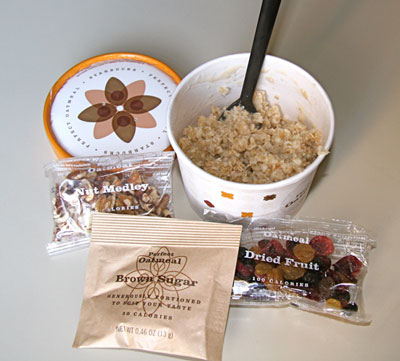
Of course, if you plan to make steel cut oats by yourself, it can easily take 30 minutes (but it’s worth it!).  I’ve also heard great things about using a crockpot and leaving it overnight.  What’s your favorite breakfast?
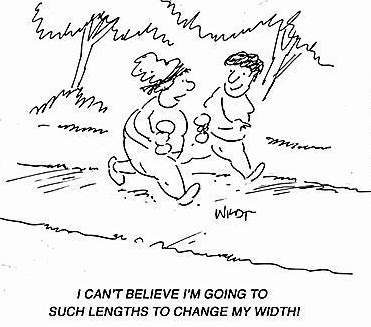
Is Running Making You Fat?

Once upon a time, I could run every day. I was rarely sleep deprived, ate as much as I wanted and enjoyed long, scenic runs through the fields of Grantchester. Life was good.

Then I joined the world of private equity and my 15 hour work days led to a 10lb weight gain. Exhausted and burned out, I brought up the idea of working out in the evenings to a female manager. “You shouldn’t even dream of leaving your desk this year. Unless, of course you want to go in your own time before work.” Sadly, my “own time” consisted of a 7am-8am slot which, after nights that often ended at midnight in the office, was none too appealing. A year flew by, my hours improved, and I began squeezing in evening trips to my company’s luxurious gym and coming back to the office for dinner and more work.  The weight came off, my energy came back and heck I ran a half marathon.

All this running and I never really took to the treadmill. I’d found a spectacular run along the banks of the Thames and used it as a motivator to get me through those painful Sundays in the office.  I ran through Hyde Park in the mornings, through Regent’s Park on the weekends and through whatever city park I could find during European business trips. I ran whether I was tired, sick or upset. I ran through rain, snow, hail and heat (and in the case of my first half marathon, all four). I ran until I moved to New York and discovered that it just wasn’t fun to run outside anymore. Boo.

Now that I’m in San Francisco, I’m starting to run more regularly again, albeit at a gym.  While I’m still getting the “endorphin high” and that strange twitching if I skip a day, I’ve definitely noticed that I’m NOT losing any weight. In fact, I may even be *gasp* gaining some! Now, I have to note here that outside of shedding some initial weight, running has never made me thinner, but is it possible that running ON A TREADMILL can actually make you fat?

We all know that cardio makes you hungry and it’s easy to overeat when you think you have a license to indulge a teeny bit more, but I wonder if there’s something more fundamental at play here. We’ve all seen them – those poor, exhausted souls who run all the time, yet never seem to lose any weight. Are they fat because they run too much??

The Metabolism aka “Skinny Fat” Theory:
According to Gym Spy, Ryan, YES running can make you fat. Excessive cardio eats away at your muscle mass and actually lowers your metabolism, making you “skinny fat”.

“When you run at the same pace for a long time, your body needs energy to keep going. So it turns to the best source … not only your saddlebags but your lean sexy muscle. And since it takes calories and energy to keep muscle, the more muscle you lose the slower your metabolism. If you used to burn 1,800 calories a day doing nothing, you may now only burn 1,600 calories.”

Isaiah White, Florida fitness instructor, echoes this theory, while the author of this fantastic article explains in scary detail how running can actually turn your body into a “fat storing machine”.

The Exercise Efficiency Theory:
“Regular running improves exercise efficiency, meaning that you burn progressively fewer calories while performing the same amount of activity. If you run for 30 minutes three times a week at the same speed on a treadmill, you’ll be burning fewer calories one month later. If you’re still doing the same pathetic half-hour treadmill jog ten years later, you can imagine how efficient you’ll have become at running, but how inefficient you’ll have become at burning fat.”

The Testosterone Theory:
An interview with nutrition and supplementation expert Dr Eric Serrano reveals that combining low carbs and traditional cardio will burn fat in the muscles but not subcutaneous fat, which is found in the belly and legs.  He says “the more cardio you do, the lower testosterone levels will be. And cortisol will increase, which is responsible for thick abdominal fat and lower body fat in women.” Oh, grrreat.

The Primal Health Theory:
Another great read is “a case against cardio” where Mark Sisson argues that we are simply not biologically suited to long periods of high-intensity aerobic exercise. It is much better, he says to build aerobic capacity slowly and steadily, training your body to derive more energy from fats (and not glucose) and building muscle with occasional quick bursts of speed and intensity.

All pretty interesting stuff, especially when you consider the amount of brainwashing we’ve experienced around the unlimited virtues of running. Is cardio activity really just a creation of the fitness industry? Are we biologically unsuited to running long distances and raising our heart rates to ridiculously high levels?

Weight loss / gain aside, there are still many, many benefits to running though and I enjoy it too much to give it up.  If you love running, but also want to lose weight, you should couple it with resistance, strength and interval training. All of the above can boost your resting metabolism, tone and lengthen your muscles and keep you challenged. But that’s a post for another day!

Some Scary Stats on Obesity

Obesity Rates for American Adults - it's a fat south and a skinny Colorado

After making the previous post, I was browsing through the latest “F as in Fat: How Obesity Threatens America’s Future 2010” report and found some interesting stats.

2/3 = Fraction of US adults that are overweight (BMI of 25-30) or obese (BMI of >30).
1/3 = Fraction of US children (age 10-17) that are obese or overweight.

And, from a great pro-vegetarian website

3x = The rate of prevalence of obesity amongst meat-eaters vs. vegetarians.
9x = The rate of prevalence of obesity amongst meat-eaters vs. vegans.

Also, take a look at this for a candid evaluation of the benefits and downsides of a vegetarian / vegan diet.

Virtuous Vegetables

“… I really wouldn’t mind the fly except that I’m a vegetarian”

It always amuses me when I’m out with new people and I order a vegetarian mains at dinner. Not because I’m laughing at myself or because I find vegetables funny, but because, by now, it’s become amusingly easy to anticipate the natural question that such a choice begets: “Oh, I didn’t realize you were a vegetarian?”.

I say question, and it usually is. Usually, it’s a well-intentioned expression of surprise and curiosity, a conversation-starter that, at the very least, justifies some more discussion of the topic and, with the right tone of voice, maybe even some sort of pseudo intellectual debate.

Unfortunately, I rarely get to go down that path because I am not, actually, vegetarian. I order the occasional vegetarian entree because I genuinely like vegetables. I know, I know, why go out to eat well..uh…a vegetable?  Well, sometimes it’s because I’m not hungry enough for meat. Sometimes I want a change of pace with something light and refreshing. Or sometimes (and brace yourself, because this’ll sound crazy), sometimes I’ll see an exciting sounding vegetarian dish on the menu and I’ll just order it.

Jokes aside, all of these situations just make me realize how much it sucks to eat out as a vegetarian. I mean, where are we as a society when there are people who believe that the only reason someone might pay good money for a vegetarian meal is because they are bound by some sort of philosophical, religious or physiological constraint? Doesn’t that imply that we consider vegetarian food inferior – something eaten out of limitation rather than a choice? Applying this lens together with a “you are what you eat” philosophy quickly leads to an extremely negative viewpoint on vegetarianism in general.

Even if you can withstand the constant barrage of curious, well-intended questions, I cannot imagine that eating out as a vegetarian can be particularly exciting. While every restaurant menu usually has something veg-friendly on it, there’s little guarantee that their vegetable offering lives beyond the realm of cold salads and starchy carbs. Not exactly something I’d want to splurge on.

After reading Skinny Bitch (I’m not proud of the title either but its a great book) a few years ago, I became a vegan. The shocking statistics and scary research presented by the two authors was compelling enough to make me never want to go near meat or any kind of dairy product ever again. My resolve lasted about 5 weeks. And I might add that 3 of those weeks were spent in India – a country with possibly the most vegetarian-friendly cuisine in the world. As soon as I got back to England, my impractical New Year’s resolution started heading out the window.

So how do we make the world more vegetarian-friendly? I came across this fantastic blog recently, written by a vegetarian who also happens to be in the middle of food school. Check out her ideas.

Just to be clear though, I’m not advocating some sort of self-righteous vegan lifestyle at all. What I am advocating, is eating more vegetables.

I did some digging and there’s quite a bit of conflicting information as to what the “best” vegetables really are. So in lieu of that somewhat arbitrary title, here are five delicious and nutrient packed veggies I highly recommend tucking in to.

5. Asparagus

This almost leafless member of the lily family is rich in folic acid (vitamin B9), which has been shown to reduce levels of an inflammatory substance called homocysteine which, in turn, is linked with heart disease. One serving of asparagus (5 spears) provides over 60% of the recommended daily intake. Asparagus also contains vitamins A, B6, C, K, protein, some beta carotene, potassium, zinc and fiber. It has no fat, no cholesterol and is low in sodium. Asparagus may also improve the health of your digestive tract by sparking production of friendly flora (like Lactobacillus and Bifidobacteria).

Grilled, steamed or wrapped in bacon – asparagus is a firm favourite

4. Sweet Potatoes

A cup of baked sweet potatoes with skin is an excellent source of vitamin A in the form of beta carotene as it contains 13107 IU of this powerful antioxidant. It is also a very good source of manganese and Vitamin C as well as Vitamin B6 and the minerals copper, fiber, potassium and iron. Purple-fleshed sweet potatoes are rich in anthocyanins and have the highest antioxidant activity among sweet potato varieties. These vegetable all-stars are not only delicious and versatile but weigh in at just 95 calories per serving.

Pretty much nothing comes close to sweet potato fries

3. Dark Leafy Greens

Dark green leafy vegetables are, calorie for calorie, perhaps the most concentrated source of nutrition of any food. They are a rich source of minerals (including iron, calcium, potassium, and magnesium) and vitamins, including vitamins K, C, E, and many of the B vitamins. They also provide a variety of Phytochemicals including beta-carotene, lutein, and zeaxanthin, which protect our cells from damage and our eyes from age-related problems, among many other effects. Dark green leaves even contain small amounts of Omega-3 fats. Perhaps the star of these nutrients is Vitamin K. A cup of most cooked greens provides at least nine times the minimum recommended intake of Vitamin K, which is believed to help regulate blood clotting, protect against osteoporosis, reduce inflammation and prevent diabetes.

Kale, Collard Greens, Spinach, Swiss Chard and Dandelion

2. Carrots

Carrots are the richest vegetable source of pro-vitamin A carotenes, a phytonutrient which has shown to help protect vision and is associated with reduced risk of heart disease and certain types of cancers. This orange root crop is also a very good source of vitamins C and K, dietary fiber and potassium and a good source of B complex, manganese, molebdenum, phosphorus, magnesium and folate. Carrots are known to help protect eyes, skin, hair as well as boost energy. If, like me, you find eating carrots kind of boring, try mixing half and half carrot juice with OJ – it doesn’t get much better than this.

Bugs Bunny knew what he was doing

1. Tomatoes

Tomatoes are one of nature’s most nutrient dense foods. Even though beta carotene gets all the press as a health food, the most powerful cancer-kicking carotenoid is really lycopene. Lycopene delivers twice the antioxidant power of another top antioxidant, vitamin E. Yet, you’d have to eat a hundred times as many calories in vitamin E-containing foods to get the antioxidant power that’s in one tomato. Lycopene can help lower the risk of all cancers, particularly prostate cancer. The body absorbs more lycopene from tomatoes when they are cooked into sauces, pastes, and salsa or when eaten with olive oil. Additionally, tomatoes contain around 4,000 phytonutrients, 1/2 a gram of fiber, 25% of the RDA for vitamin A, a gram of protein, a bit of vitamin B6, riboflavin, niacin, almost half the RDA for vitamin C and even a pinch of minerals. All that for only 26 calories? Get going!

And the winner is…