Virtuous Vegetables

“… I really wouldn’t mind the fly except that I’m a vegetarian”

It always amuses me when I’m out with new people and I order a vegetarian mains at dinner. Not because I’m laughing at myself or because I find vegetables funny, but because, by now, it’s become amusingly easy to anticipate the natural question that such a choice begets: “Oh, I didn’t realize you were a vegetarian?”.

I say question, and it usually is. Usually, it’s a well-intentioned expression of surprise and curiosity, a conversation-starter that, at the very least, justifies some more discussion of the topic and, with the right tone of voice, maybe even some sort of pseudo intellectual debate.

Unfortunately, I rarely get to go down that path because I am not, actually, vegetarian. I order the occasional vegetarian entree because I genuinely like vegetables. I know, I know, why go out to eat well..uh…a vegetable?  Well, sometimes it’s because I’m not hungry enough for meat. Sometimes I want a change of pace with something light and refreshing. Or sometimes (and brace yourself, because this’ll sound crazy), sometimes I’ll see an exciting sounding vegetarian dish on the menu and I’ll just order it.

Jokes aside, all of these situations just make me realize how much it sucks to eat out as a vegetarian. I mean, where are we as a society when there are people who believe that the only reason someone might pay good money for a vegetarian meal is because they are bound by some sort of philosophical, religious or physiological constraint? Doesn’t that imply that we consider vegetarian food inferior – something eaten out of limitation rather than a choice? Applying this lens together with a “you are what you eat” philosophy quickly leads to an extremely negative viewpoint on vegetarianism in general.

Even if you can withstand the constant barrage of curious, well-intended questions, I cannot imagine that eating out as a vegetarian can be particularly exciting. While every restaurant menu usually has something veg-friendly on it, there’s little guarantee that their vegetable offering lives beyond the realm of cold salads and starchy carbs. Not exactly something I’d want to splurge on.

After reading Skinny Bitch (I’m not proud of the title either but its a great book) a few years ago, I became a vegan. The shocking statistics and scary research presented by the two authors was compelling enough to make me never want to go near meat or any kind of dairy product ever again. My resolve lasted about 5 weeks. And I might add that 3 of those weeks were spent in India – a country with possibly the most vegetarian-friendly cuisine in the world. As soon as I got back to England, my impractical New Year’s resolution started heading out the window.

So how do we make the world more vegetarian-friendly? I came across this fantastic blog recently, written by a vegetarian who also happens to be in the middle of food school. Check out her ideas.

Just to be clear though, I’m not advocating some sort of self-righteous vegan lifestyle at all. What I am advocating, is eating more vegetables.

I did some digging and there’s quite a bit of conflicting information as to what the “best” vegetables really are. So in lieu of that somewhat arbitrary title, here are five delicious and nutrient packed veggies I highly recommend tucking in to.

5. Asparagus

This almost leafless member of the lily family is rich in folic acid (vitamin B9), which has been shown to reduce levels of an inflammatory substance called homocysteine which, in turn, is linked with heart disease. One serving of asparagus (5 spears) provides over 60% of the recommended daily intake. Asparagus also contains vitamins A, B6, C, K, protein, some beta carotene, potassium, zinc and fiber. It has no fat, no cholesterol and is low in sodium. Asparagus may also improve the health of your digestive tract by sparking production of friendly flora (like Lactobacillus and Bifidobacteria).

Grilled, steamed or wrapped in bacon – asparagus is a firm favourite

4. Sweet Potatoes

A cup of baked sweet potatoes with skin is an excellent source of vitamin A in the form of beta carotene as it contains 13107 IU of this powerful antioxidant. It is also a very good source of manganese and Vitamin C as well as Vitamin B6 and the minerals copper, fiber, potassium and iron. Purple-fleshed sweet potatoes are rich in anthocyanins and have the highest antioxidant activity among sweet potato varieties. These vegetable all-stars are not only delicious and versatile but weigh in at just 95 calories per serving.

Pretty much nothing comes close to sweet potato fries

3. Dark Leafy Greens

Dark green leafy vegetables are, calorie for calorie, perhaps the most concentrated source of nutrition of any food. They are a rich source of minerals (including iron, calcium, potassium, and magnesium) and vitamins, including vitamins K, C, E, and many of the B vitamins. They also provide a variety of Phytochemicals including beta-carotene, lutein, and zeaxanthin, which protect our cells from damage and our eyes from age-related problems, among many other effects. Dark green leaves even contain small amounts of Omega-3 fats. Perhaps the star of these nutrients is Vitamin K. A cup of most cooked greens provides at least nine times the minimum recommended intake of Vitamin K, which is believed to help regulate blood clotting, protect against osteoporosis, reduce inflammation and prevent diabetes.

Kale, Collard Greens, Spinach, Swiss Chard and Dandelion

2. Carrots

Carrots are the richest vegetable source of pro-vitamin A carotenes, a phytonutrient which has shown to help protect vision and is associated with reduced risk of heart disease and certain types of cancers. This orange root crop is also a very good source of vitamins C and K, dietary fiber and potassium and a good source of B complex, manganese, molebdenum, phosphorus, magnesium and folate. Carrots are known to help protect eyes, skin, hair as well as boost energy. If, like me, you find eating carrots kind of boring, try mixing half and half carrot juice with OJ – it doesn’t get much better than this.

Bugs Bunny knew what he was doing

1. Tomatoes

Tomatoes are one of nature’s most nutrient dense foods. Even though beta carotene gets all the press as a health food, the most powerful cancer-kicking carotenoid is really lycopene. Lycopene delivers twice the antioxidant power of another top antioxidant, vitamin E. Yet, you’d have to eat a hundred times as many calories in vitamin E-containing foods to get the antioxidant power that’s in one tomato. Lycopene can help lower the risk of all cancers, particularly prostate cancer. The body absorbs more lycopene from tomatoes when they are cooked into sauces, pastes, and salsa or when eaten with olive oil. Additionally, tomatoes contain around 4,000 phytonutrients, 1/2 a gram of fiber, 25% of the RDA for vitamin A, a gram of protein, a bit of vitamin B6, riboflavin, niacin, almost half the RDA for vitamin C and even a pinch of minerals. All that for only 26 calories? Get going!


And the winner is…

To Yelp or Not to Yelp

Yelp is courting bad press, again. Earlier this month, the company released an update to its iPhone App that will enable users with the highest number of check-ins to become “Duke” or “Duchess” of a venue and reap special benefits. Fair enough Yelp, you’ve gotta keep up with the Jones’ of tech, but at least come up with your own name for a badge. It’ll be interesting to see how Foursquare, which has already dubbed hundreds of thousands of users “Mayor”, will respond to such a blatant rip-off (are they still nursing a grudge from the check-in copycat?).

Don’t get me wrong. I’ve been a Yelp fan and “registered user” for years and I visit the site nearly every day for user ratings, directions, pictures and even to post the occasional review. But the controversy surrounding the company just never seems to end, and it’s starting to feel like the signal to noise ratio of its reviews may be getting weaker and weaker…

The allegations began in early 2009 when dozens of business owners claimed that Yelp was manipulating user reviews (deleting positive reviews and highlighting negative ones) in order to extort advertising revenue from them. The MO of Yelp sales reps, as reported by several newspapers, is to call a business owner with the standard sales pitch, persist in calling even after he/she has turned down the service and then threaten him/her with negative reviews. Is this true? Or are these just bad businesses searching for a scapegoat after an inevitable demise?

Yelp CEO Jeremy Stoppelman vehemently denies the claims (and I want to believe him). He explains that Yelp uses a computer algorithm to rank the user reviews, displaying them in order of “usefulness” rather than chronology (unlike typical user comments). This “usefulness” is determined based on a number of criteria including the ranking / popularity of the reviewer and the frequency with which he/she posts reviews. Sound familiar? Digg ranks its stories and comments with, what many users consider to be, the ultimate black box algorithm but allows users to vote up or bury comments (unlike Yelp).

Stoppelman says the Yelp algo protects against restauranteurs and retailers having their friends and family post glowing reviews and bumping up the venue’s ratings. It does this by strategically burying and highlighting certain reviews. So it isn’t an unbiased system, clearly. It is just unclear whether the bias here is “fair” or extortionary.

As the protests gained traction, a civil action lawsuit was filed against Yelp by 10 business owners alleging unfair business practices. On April 5, Yelp acknowledged the issue. It added links to deleted comments and took away paying members’ ability to place positive evaluations atop their profiles. The outcome is TBD.

But there’s another issue with Yelp’s model that continues to bother me, and that is the user motivation behind writing a review. The typical user will be inclined to post a review in one of two cases: either he had a stellar experience and felt compelled to share his joy with the world or he had the worst experience ever and wanted to tell everyone how much it sucked. This means the majority of reviews are going to fall into an extreme bucket and the average restaurant/retailer will either get a much better, or much worse, rating than it actually deserves.

I’m hoping (guessing) that Yelp’s algo accounts for this somehow (give greater weighting to the frequent and equitable reviewers?) but since moving to San Francisco reviews, I’m losing faith. So many places that me and my friends absolutely adore have mediocre Yelp ratings and so many of the reviewers cite the strangest rationales for their poor ratings (see below) but still receive prime real estate (“above the fold”) on the review page.

Yelp Review of the Slanted Door - it seems there is less value to being inconspicuous in SF

Yelp Review of Pomelo - I've eaten here and would have called it "cosy and bustling" rather than cramped. But then again, maybe that's a positive only in the East Village...

Am I grossly out of whack with the San Francisco foodie? Or…could it be that more reviews on Yelp (in SF) = less accuracy?

Its unclear, but Yelp’s move to go social, by partnering with Facebook, may be one solution to the above. By pulling your social graph into the site, Yelp enables you to see exactly where your friends have been going (thanks for checking in), how often they go there (number of check ins) and what they think of it (reviews). Stalking aside, the value to this seems tremendous. People are much more comfortable trusting their friends’ opinions, recommendations and biases vs. those of Yelp’s unknown millions.

Whether socializing the site will be the silver bullet to all of Yelp’s woes remains to be seen, but it still feels like there’s a market gap and a recommendation problem here that needs solving. It just may not be in Yelp’s destiny to solve it.

Why I love San Francisco’s Ferry Building

Market and Mission, two of San Francisco’s most famous streets, lead to the same jewel at the head of the Embarcadero – the Ferry Building. This beautiful structure, built over a hundred years ago, looks out onto a breathtaking expanse of bright blue sparkling water.  Ferry service continues to run North through the San Francisco Bay to Tiburon, Sausalito, Angel Island and Vallejo, as well as East, to Oakland and Alameda. Fortunately, public transport is not all this magical building has to offer. It is also an epicenter of gourmet food.

Purveyors of everything ranging from organic coffee to farm fresh fungi line the aisles of its spacious interior, attracting a good mix of faithful locals and inspired tourists. Tiny store fronts serving decadent gelato and delectable chocolate peek out from between larger shops selling cookware and recipe books. The Ferry Building’s flagship restaurant, the Slanted Door (one of my all-time favourites), caters to a higher-end crowd seeking haute Vietnamese cuisine and luscious cocktails. Taylor’s Automatic Refresher, the other gem of the building, is a San Francisco institution, serving up gourmet burgers, must-try sweet potato fries and an assortment of old-school milkshakes and lemonades.

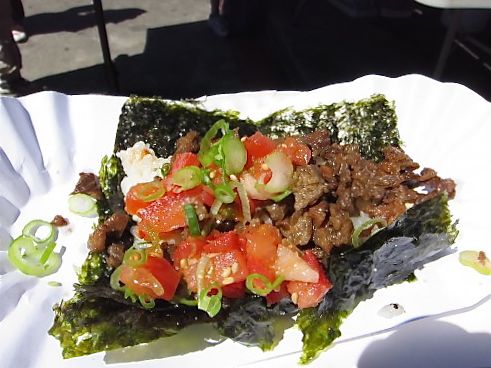
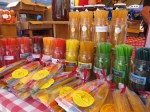
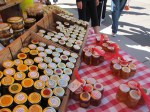
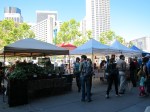
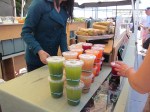
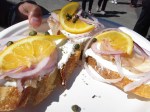
As if this weren’t enough, every Saturday, Tuesday and Thursday, the Ferry Building outdoes itself by playing host to an outstanding Farmer’s Market. Stalls of fresh fruit, local vegetables, aromatic herbs and pretty flowers line the front of the building, while tents selling hot snacks and brunch specials squeeze together in the back. We tried sturgeon with capers, onions and cream cheese on a freshly baked baguette, followed by “korean tacos” comprising deliciously spiced minced kobe and sticky rice wrapped in seaweed paper and lastly, a cheese-free but melt-in-the-mouth delicious pumpkin lasagna. We also picked up a few items from the vast range of regional artisan specialties including cheese, jams, sauces as well as olive oils, specialty salts and cured meats.

A huge fan of local produce and Farmer’s Markets, I only wish New York or Boston would follow suit. After being spoiled by two wonderful years of Borough and Old Spitalfields Market, I’ve struggled to find similar wonders in US cities. Ithaca Farmer’s Market, held every weekend in upstate NY, is surprisingly good and extremely popular amongst tourists and Cornell students alike. Are you listening Boston?

A Fortnight in Fog City

I’ve been in San Francisco nearly two weeks now (time flies!) and am thoroughly enjoying what’s looking to be a fantastic summer. After a couple of do-nothing days in NYC, I flew out to join the bf who, conveniently, will be spending the next month or so in SF for work.

We’re staying in Nob Hill which, as the name suggests, is no friend to the faint hearted. My first week here, I nearly died climbing up the steep incline that leads home. I’m getting better at it but continue to be overtaken by pesky locals who make climbing a 60 degree gradient look like sliding on ice. I have also learned that wearing heels in SF is social suicide (you *will* get left behind).

From Nob Hill, it takes me about 40 minutes to get to the tech start up I’ve been working at, located on yet another, [Potrero] Hill. The Muni is certainly not the finest public transport I’ve taken, but at $2 each way, I really can’t complain. So many friends are spending ~3 hours/day driving back and forth from the Valley that I’m pretty happy to be able to re-discover Milan Kundera on the train.

Anyway, on to the food! We’ve been oyster shucking, boatside brunching, farmer’s market-ing, tea tasting and generally face-stuffing and, so far, the City has not disappointed. More to come but here’s the low down on some great local restaurants.

Cafe Kati, a cute little place in Pac Heights offers a fun menu of Asian Fusion delights ranging from old classics like chicken lettuce cups to creative hits like peanut crusted prawns with green papaya, mint and fresh basil. The ambience is small, cosy and intimate. It feels a little like a quaint old bookstore. Service is friendly and the wine list is great. We tried the dragon roll, the prawns and the sliders – servings are bigger than you’d expect and the food is melt in the mouth delicious.
Damage: $70 for two, including drinks (but then we didn’t order entrees)

Next, we tried Frascati, a Mediterranean style bistro located on the corner of a lovely tree-lined street not far from where we live. There are a couple of very cute looking restaurants on this block, but Frascati stands out for a unique and seasonally fresh menu. The Duck Confit Salad was fabulously tasty, the Dungeness Salad good, but very small. The big let down came from the desserts. We ordered the bread pudding and the apple cobbler and both were giant sized portions of mediocre kitchen fare. Nothing memorable about them and certainly out of sync with the rest of the restaurant’s delicate, deliberate sensibility.

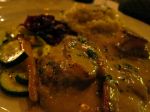
Another great restaurant tucked away on a quiet corner at the top of Nob Hill is Venticello, which means “soft breeze” in Italian. This hidden gem exudes old world romance and Tuscan charm. The lights are dim, the tones are warm, the tables are candle lit and the doors and windows are thrown open to the cool night air. The maitre’D was warm and welcoming and the service, prompt and professional. The Carpaccio and Polenta con Portobello were absolutely divine – creative, original and beautifully presented. The meat pasta was so-so and somewhat uninspiringly arranged in a plain white bowl. The dish of the night however, was definitely the veal Scallopini – absolutely to die for. Served with tiger prawns and a basil cream sauce, this is apparently their most popular dish and something I could not get enough of!

Back from the Dead [Sea]: HBS Israel Trek 2010

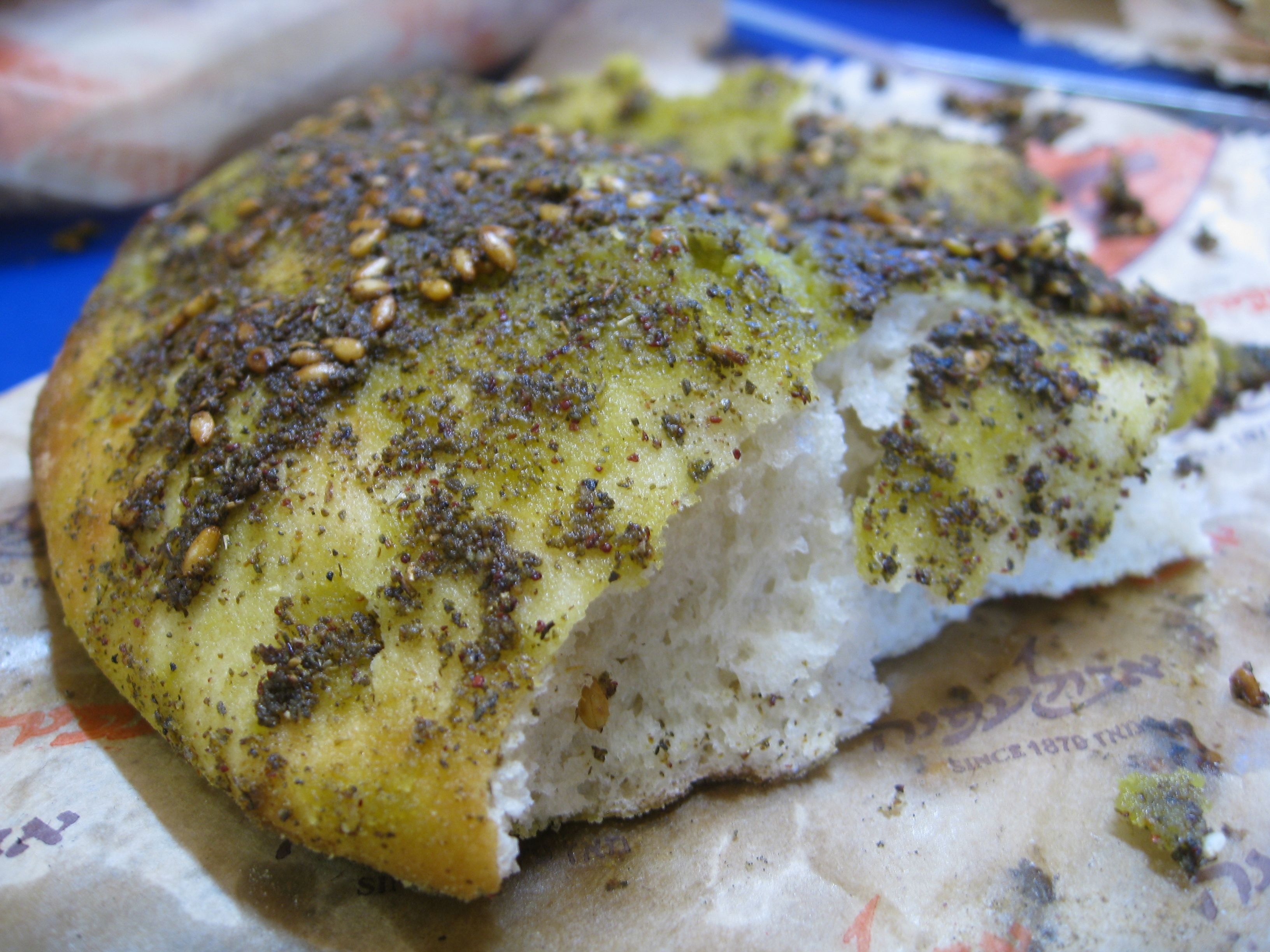
Fresh from the oven and doused in olive oil and za'atar - delicious

Israel is widely known as the promised land – the land of milk and honey. White sands glisten along dramatic coastlines, lush orchards of figs, pomegranates and olives litter ancient landscapes and beautiful partygoers throng vibrant resorts. But after ten days of intense travel with a group of 80 HBS students, Israel seems much more like a land of paradoxes – a complex blend of antiquity and modernity, religion and secularity, patriotism and rebellion.

The center of three major religions, Israel attracts millions of tourists each year. However, in spite of (or rather because of) its status as one of the holiest places on earth, this tiny strip of land has seen centuries of conflict, turmoil and bloodshed. After a drawn-out battle against the Palestinian Arabs, Israel declared independence in 1948, only to face fresh attacks from Jordan, Egypt, Syria, Iraq and Lebanon. The now famous Israeli Defense Forces were formally established on May 26, 1948 and, by March of the following year, the IDF had miraculously repelled Arab forces to secure Israel’s borders. Unfortunately this was not the end. During the 6 Day War of 1967, Israel pre-emptively attacked Egypt, Jordan and Syria to regain control of the Sinai Peninsula, the West Bank, the Golan Heights, the Gaza Strip and East Jerusalem. Egypt and Syria retaliated with a surprise attack in 1973, leading to thousands of casualties that highlighted Israel’s vulnerabilities and the need for peace in the Middle East. The Arab-Israeli conflict has persisted over the decades, manifesting itself in two wars with the PLO in Lebanon (1982 and 2006) and two Intifada uprisings in Palestinian territories (1987 and 2000). More recently, Israel imposed an embargo on the Gaza Strip after the territory fell under Hamas rule three years ago. Last week, a flotilla of 6 Turkish ships carrying 10,000 tons of aid for the impoverished Gaza Strip was intercepted by Israeli forces, causing a significant setback in relations with Turkey, a key ally in the Muslim world.

Given its political backdrop and religious tensions, I was surprised at how secular Israeli society actually feels. Jews, Christians and Muslims peacefully co-habit the densely populated Old City within Jerusalem and flyers promoting the latest clubs litter the glitzy boardwalks of Eilat. Hordes of sun-worshipping Tel Avivians flock to the sandy beaches of the Mediterranean and, with the exception of Shabbat (the day of rest), every hour in the city feels like it’s bursting with modern life. Our guide for the trip spoke fondly of King Hussein of Jordan and his work towards signing a landmark peace treaty with Israel.

“We are desperately seeking peace with our neighbours. If we can build more friendships in the region, we’d absolutely be willing to cede land.”

Even more encouraging was our Arab-Israeli taxi driver’s impassioned speech for peace. “The people of the West Bank are trapped in a dead-end society. They cannot work and they cannot leave. I grew up here, an Arab in Jerusalem, and I know that we, the people, want peace. We want this to end. It is the politicians who want the conflict.”

Another remarkable paradox of modern day Israel is the co-existence of a strong culture of rebellion with a mandatory conscription for both men and women to the IDF. Everywhere we went, Israelis spoke proudly of their distaste for authority and their passion for disagreeing with the status quo (regardless of what it is).

“We don’t queue in Israel. Life is all about cutting lines”.

The cultivation of this particular personality trait on a national level appears to have created psychological unity among the Israeli people (above and beyond religious and ethnic similarities) and, perhaps more importantly, spawned a culture of risk-taking and entrepreneurship. Interestingly, Israel’s enormous military budget (~9% of GDP vs. ~ 4% for the US) necessitated by its location in a hostile Middle East, has fueled a booming high tech industry and a desire by its people to “build something” rather than work in say, financial services.

Blessed with lush, dramatic landscapes, gorgeous beaches and delicious and wonderfully spicy food, it is hard not to fall in love with Israel. After four nights in Tel Aviv, two in Jerusalem, three in Eilat and one in Kfar Blum, we were averaging 4 hours of sleep and many more units of alcohol. Despite the exhaustion, the heat and the sensory overload, the thought of leaving “the Land” and the fabulous group of 80 crazy partners in crime, was quite a downer. Israeli people are wonderfully warm and incredibly hospitable and the idea of a ten hour red-eye with American plane food was far less appealing than a hot pitta filled with spicy hummus and perfectly crisped falafel 😉